
“My mission is to both reduce the wealth inequality and shrink the government here in the state of Illinois. We are going to accomplish this by cutting spending top-down, and by cutting taxes bottom-up!” – Andrew Cottingham
Bottom-Up Tax Cuts: The Solution to the Affordability Crisis
We are facing an affordability crisis, and neither side has a solution.
My number one priority is to cut taxes bottom-up for the poor, working, and middle class not just here in the State of Illinois, but also across the United States as well. The taxes I plan to target include, but are not limited to, the income tax, sales tax, and property tax.
Income Tax:
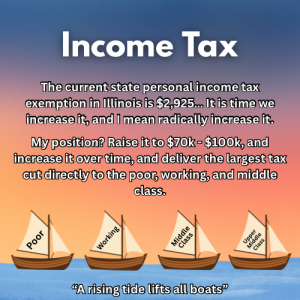
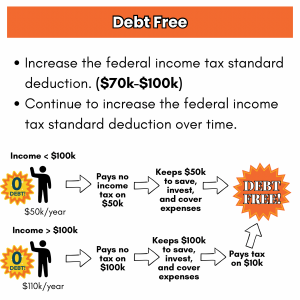
I believe the first step in helping those living paycheck-to-paycheck is to stop taxing their paycheck, which is why I advocate for a radical increase in the state personal income tax exemption. I support increasing it from $2,925 to $70k-$100k, for doing so would allow residents to use more of their own money to cover expenses, save, invest, and pay off debt! This is how you grow the middle class, support small businesses, and increase homeownership statewide.
- No Tax on Unemployment Benefits: My plan, in accordance with cutting the state income tax bottom up, is to stop taxing unemployment benefits in the State of Illinois.
- No Tax on Tips: In accordance with cutting the state income tax bottom up, I will also eliminate the income tax on all cash/electronic tips.
- No Tax on Overtime: In accordance with cutting the state income tax bottom up, I will also eliminate the income tax on all overtime pay. We should be rewarding our workforce for their extra work, not punishing them with additional taxation! I believe we will see an increase in productivity, an increase in employee satisfaction/fulfillment, and a decrease in poverty within our workforce.
When you cut taxes bottom-up, you will see families flourish, not founder, for a rising tide lifts all boats.
Debt First Policy:
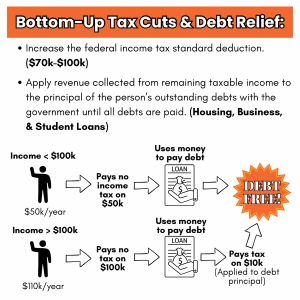
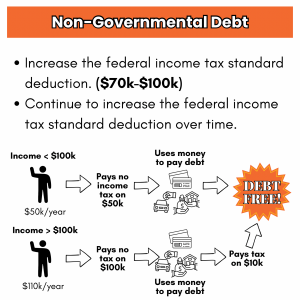
We also have a personal debt problem. Far too many people are in debt due to rising costs in goods and services, housing, healthcare, education, and even in starting or owning a business; additionally, debt is also a result of losing resources to taxes, which is why I firmly believe that bottom-up tax cuts will help lower personal debt.
In my “Debt First Policy,” which is described in the graphics below, revenue collected from a person’s taxable income will first be directly applied to the principal of their outstanding debt with the state government until all debts are paid in full. This policy would be applied until the bottom-up income tax cut is implemented, and only if a person’s income exceeds the raised personal exemption.
Sales Tax:
With the increasing cost of goods and services, and with the decrease in the value of the dollar, Americans are struggling to afford basic necessities. How can our people thrive if they can barely survive anymore?
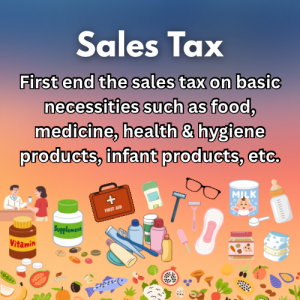
My plan is to eliminate the state sales tax on necessities first, for sales taxes directly impact the poor, working, and middle class the most here in Illinois. Eliminating the 1% grocery tax, which went into effect January 1st, 2026, is a step in the right direction; however, it is not enough. What are necessities? To me, necessities include food, medicine, health & hygiene products, infant products, etc.
- Destination Sales Tax: I will oppose and fight to repeal the destination sales tax.
- Fair Tax: I will oppose and fight against any proposal to implement a “Fair Tax” in Illinois.
- Service Tax: I will oppose and fight against any proposal to implement a tax on services in Illinois.
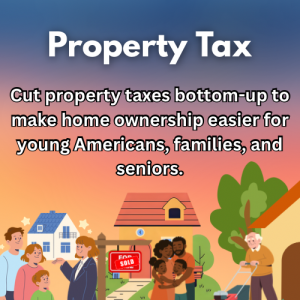
Property Tax:
We have a housing crisis, which affects everyone, especially young adults, young couples, families, and seniors.
Home ownership is an essential part of fulfilling the American Dream and building generational wealth; and whenever taxes delay the progress of our youth, stunt the growth of our families, and punish our seniors, the hope in that dream begins to fade quickly.
That is why I support cutting property taxes bottom-up. I want to make home ownership obtainable and maintainable again for our residents here in the State of Illinois.
Top-Down Spending Cuts: The Solution to Waste, Fraud, and Excessive Spending
Illinois has a spending problem, not a revenue problem…
Freeze State Spending:
The best path towards a well-balanced budget is not made through increased taxation (raising current taxes or creating new taxes) or by more regulation; instead, it will be made not only by spending ONLY what we have (not a dollar more), but also by reducing how much we spend. That is why I believe freezing state spending will be the first significant step in reversing decades of reckless spending and in lifting the current tax burden off of our residents.
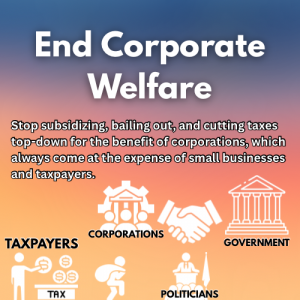
Ending Corporate Welfare:
Stop subsidizing, bailing out, and cutting taxes top-down for the benefit of corporations, which always come at the expense of small businesses and taxpayers. We need to cut spending top-down for the government, corporations, and for the wealthy altogether.
Why should taxpayers foot the bill every time? When was the last time we bailed out the poor, working, and middle-class or cut their taxes first? These are the questions we need to start asking ourselves.
We need to cut spending top-down for the government, corporations, and for the wealthy altogether, and deliver bottom-up tax cuts for the poor, working, and middle-class.
If Democrats truly care about the poor, working, and middle-class, they will support this. If Republicans truly care about shrinking government and cutting taxes, they will support this. If Independents really care about both, I bet that they will strongly support this!
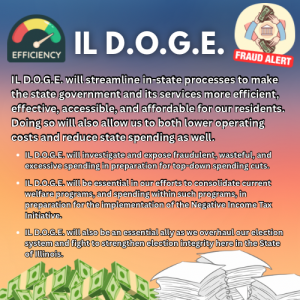
Illinois Department of Government Efficiency (IL D.O.G.E.):
I support efforts to establish a Department of Government Efficiency in the State of Illinois; for I believe doing so will allow us to lower operating costs, significantly reduce state spending through a top-down approach, and to improve our state government.
With such savings, we can deliver bottom-up tax cuts for our residents!
What will IL D.O.G.E do under my approach?
- IL D.O.G.E. will streamline in-state processes to make the state government and its services more efficient, effective, accessible, and affordable for our residents. Doing so will also allow us to both lower operating costs and reduce state spending as well.
- IL D.O.G.E. will investigate and expose fraudulent, wasteful, and excessive spending in preparation for top-down spending cuts.
- IL D.O.G.E. will be essential in our efforts to consolidate current welfare programs, and spending within such programs, in preparation for the implementation of the Negative Income Tax Initiative (see below for further details).
- IL D.O.G.E. will also be an essential ally as we overhaul our election system and fight to strengthen election integrity here in the State of Illinois.
What will IL D.O.G.E NOT do under my approach?
- Gut spending and benefits bottom-up for poor, working, and middle-class residents.
- Protect the interests of politicians, corporations, and wealthy individuals who have exploited the system, and our taxpayer dollars, to their benefit.
Overhauling Illinois Elections: Solutions for Replacing a Broken Two-Party System
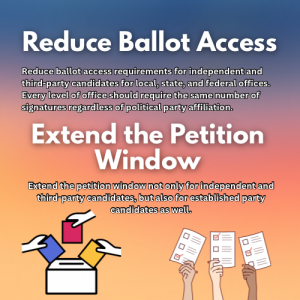
Reduce Ballot Access:
Reduce ballot access requirements for independent and third-party candidates for local, state, and federal offices. As of right now, the State of Illinois makes it nearly impossible to run for office unless you are a Democrat or Republican, which is neither democratic, nor a principle of our republic. Every level of office should require the same number of signatures regardless of political party affiliation. (If independents have to collect 2,000+ signatures for State Representative, so should Democrats and Republicans.)
Extend Petition Gathering Period:
Extend the petition window not only for independent and third-party candidates, but also for established party candidates as well.
(A) For the purpose of qualifying for placement on the ballot for any public office, independent, third-party, and established-party candidates shall be entitled to begin circulating nomination petitions on the first Wednesday of the calendar year immediately preceding the election year.
(B) The deadline for submission of such nomination petitions by independent and third-party candidates to the appropriate election authority shall be the third Monday of July in the year of the election in which the office is being sought. The deadline for submission of such nomination petitions by established party candidates to the appropriate election authority shall be filed no more than 141 days and not less than 134 days prior to the date of the primary.
(C) Nomination petitions submitted after the deadline shall be deemed invalid and shall not be considered for ballot placement.
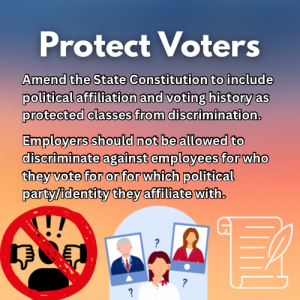
Protect Voters:
Amend the Illinois State Constitution to include political affiliation and voting history as protected classes from discrimination. No one in the State of Illinois should be discriminated against for who they vote for or for which political party/identity they affiliate with.
Abolish the Secret Ballot:
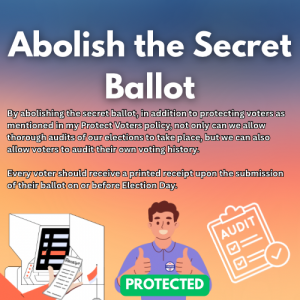
Next to California and New York, Illinois has some of the worst election integrity in the nation, which is why I support abolishing the secret ballot in the State of Illinois. By abolishing the secret ballot, in addition to protecting voters as mentioned in my Protect Voters policy, not only can we allow thorough audits of our elections to take place, but we can also allow voters to audit their own voting history. Lastly, I believe that every voter should receive a printed receipt upon the submission of their ballot on Election Day.
Write-In Ballots:
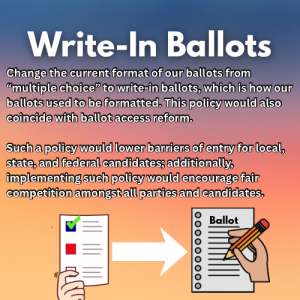
Change the current format of our ballots from “multiple choice” to write-in ballots, which is how our ballots used to be formatted. This policy would also coincide with ballot access reform. Such a policy would lower barriers of entry for local, state, and federal candidates; additionally, implementing such policy would encourage fair competition amongst all parties and candidates.
Independent Redistricting:
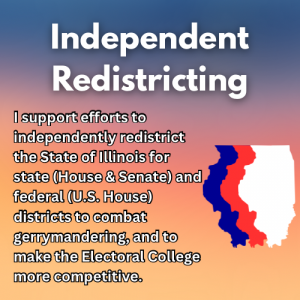
I support efforts to independently redistrict the State of Illinois for state (House & Senate) and federal (U.S. House) districts to combat gerrymandering, which undermines the will of voters and strips voters of representation.
Proportional Representation (Statewide):
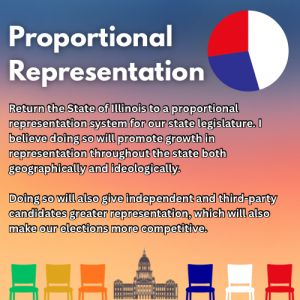
Return the State of Illinois to a proportional representation system for our state legislature. I believe doing so will promote growth in representation throughout the state both geographically and ideologically. Doing so will also give independent and third-party candidates greater representation, which will also make our elections more competitive.
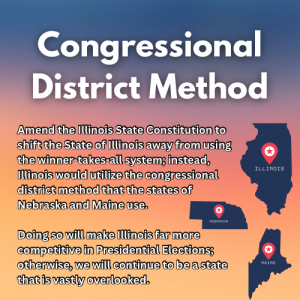
Congressional District Method (Electoral College):
Amend the Illinois State Constitution to shift the State of Illinois away from using the winner-takes-all system; instead, Illinois would utilize the congressional district method that the states of Nebraska and Maine use. I believe doing so will make Illinois far more competitive in Presidential Elections; otherwise, we will continue to be a state that is vastly overlooked.
The Negative Income Tax Initiative: A New Approach to Welfare
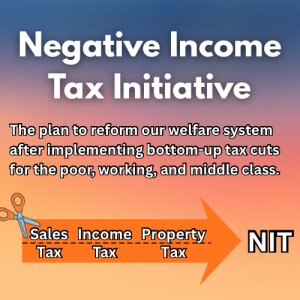
Negative Income Tax Initiative (NIT):
A consolidated welfare program inspired by Milton Friedman, which would be established after a new poverty line is defined following bottom-up tax cuts.
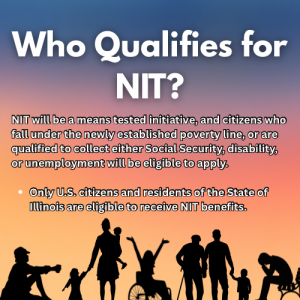
- Those who fall under the newly established poverty line, or are qualified to collect Social Security, disability, or unemployment benefits will be eligible to apply for the Negative Income Tax Initiative.
- Only United States citizens and residents of the State of Illinois will be eligible to receive NIT benefits.
- My first priority will be providing the NIT to homeless veterans.
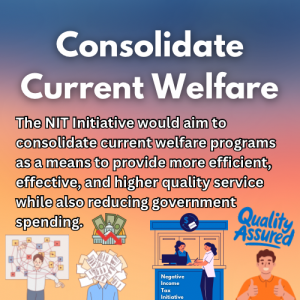
- The Negative Income Tax Initiative would aim to consolidate current welfare programs as a means to provide more efficient, effective, and quality service while also reducing government spending.
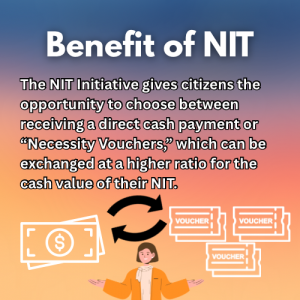
- The Negative Income Tax Initiative gives citizens the opportunity to choose between receiving a direct cash payment or “Necessity Vouchers” in exchange at a higher ratio for the cash value of their NIT.
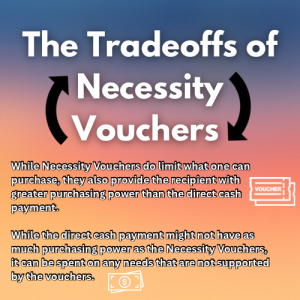
- While Necessity Vouchers do limit what one can purchase, they also provide the recipient with greater purchasing power than the direct cash payment.
- While the direct cash payment might not have as much purchasing power as the Necessity Vouchers, it can be spent on any needs that are not supported by the vouchers.
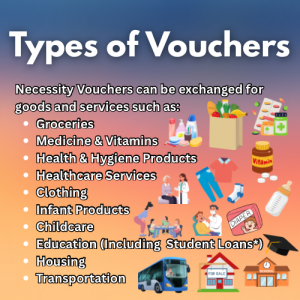
Necessity Vouchers can be exchanged for goods and services such as:
- Groceries
- Medicine & Vitamins
- Health & Hygiene Products
- Healthcare Services
- Clothing
- Infant Products
- Childcare
- Education (Including Student Loans*)
- Housing
- Transportation
The Environment: For Clean Air, Water, Soil, and Food

- I will ensure that we improve the quality of our air, water, and soil.
- I support efforts to rewild our public lands by returning native plants and animals, and by removing invasive plants and animals as well.
- I will protect threatened and endangered species. (Plants, Animals, and Fungi)
- In my efforts to end corporate welfare, I will prioritize ending subsidies and tax breaks for corporations that have harmed or are currently harming the environment.
- I will hold individuals, corporations, and government entities accountable whenever their actions negatively impact the health of our communities and our environment.
- I support regenerative agriculture practices, and will aim to make such practices more accessible, affordable, and profitable for our farmers.
Regenerative farms are currently struggling due to issues which include but are not limited to a lack of capital and long-term investors, a lack of insurance,
overregulation on a local and state level, restrictions on native plants that are deemed “nuisances” or “pests” by the state, and the lack of education
regarding regenerative agriculture. - I support pollinator conscious and friendly agriculture practices.
- I support and will embrace the development of community gardens.
- I support efforts to rewild and turn Cahokia Mounds into a National Park.
Alternative Medicine: For Better Mental Health Outcomes
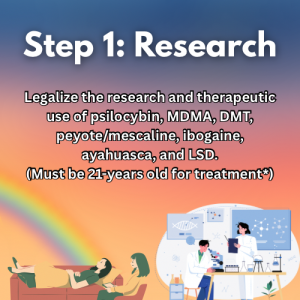
Step 1:
Legalize the research and therapeutic use of psilocybin, MDMA, DMT, peyote/mescaline, ibogaine, ayahuasca, and LSD.
(Must be 21-years old to receive treatment)

Step 2:
Decriminalize and legalize the possession, cultivation, and distribution of medicinal psilocybin.
(Must be 21-years old)

Step 3:
Legalize the possession, cultivation, and distribution of psilocybin mushrooms and products containing psilocybin.
(Must be 21-years old)
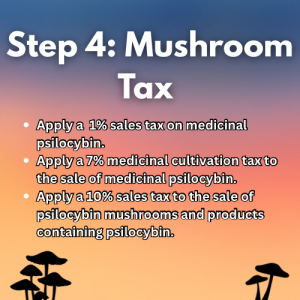
Step 4:
Apply a (1%) sales tax to the sale of medicinal psilocybin. Apply a (7%) medicinal cultivation tax to the sale of medicinal psilocybin. Apply a (10%) sales tax to the sale of psilocybin mushrooms/products containing psilocybin.
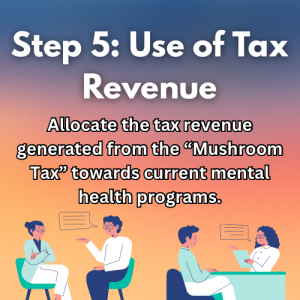
Step 5:
Tax revenue from sales tax will be allocated towards current state mental health programs.

Step 6:
Support access to therapeutic treatments utilizing psychedelics for police officers, firefighters, veterans, and other first responders suffering from trauma, PTSD, addiction, etc.
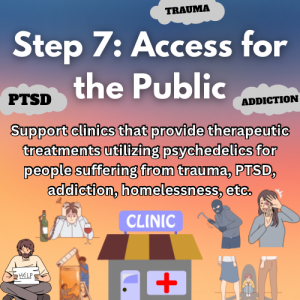
Step 7:
Support clinics that provide therapeutic treatments utilizing psychedelics for people suffering from trauma, abuse, addiction, PTSD, etc.
Step 8:
Support therapeutic treatments utilizing psychedelics as an option for the rehabilitation of the incarcerated.
Want to Contribute?
I am open to policy suggestions; however, to be
considered, policies MUST:
1. SHRINK GOVERNMENT
2. REDUCE WEALTH INEQUALITY
- Policies that reduce government more than wealth inequality are acceptable
as long as it does not increase wealth inequality. - Policies that reduce wealth inequality more than government are acceptable
as long as it does not increase government.
Policies MUST NOT:
1. INCREASE GOVERNMENT
2. MAKE WEALTH INEQUALITY WORSE
Email policy suggestions to: andrew@electcottingham.us